

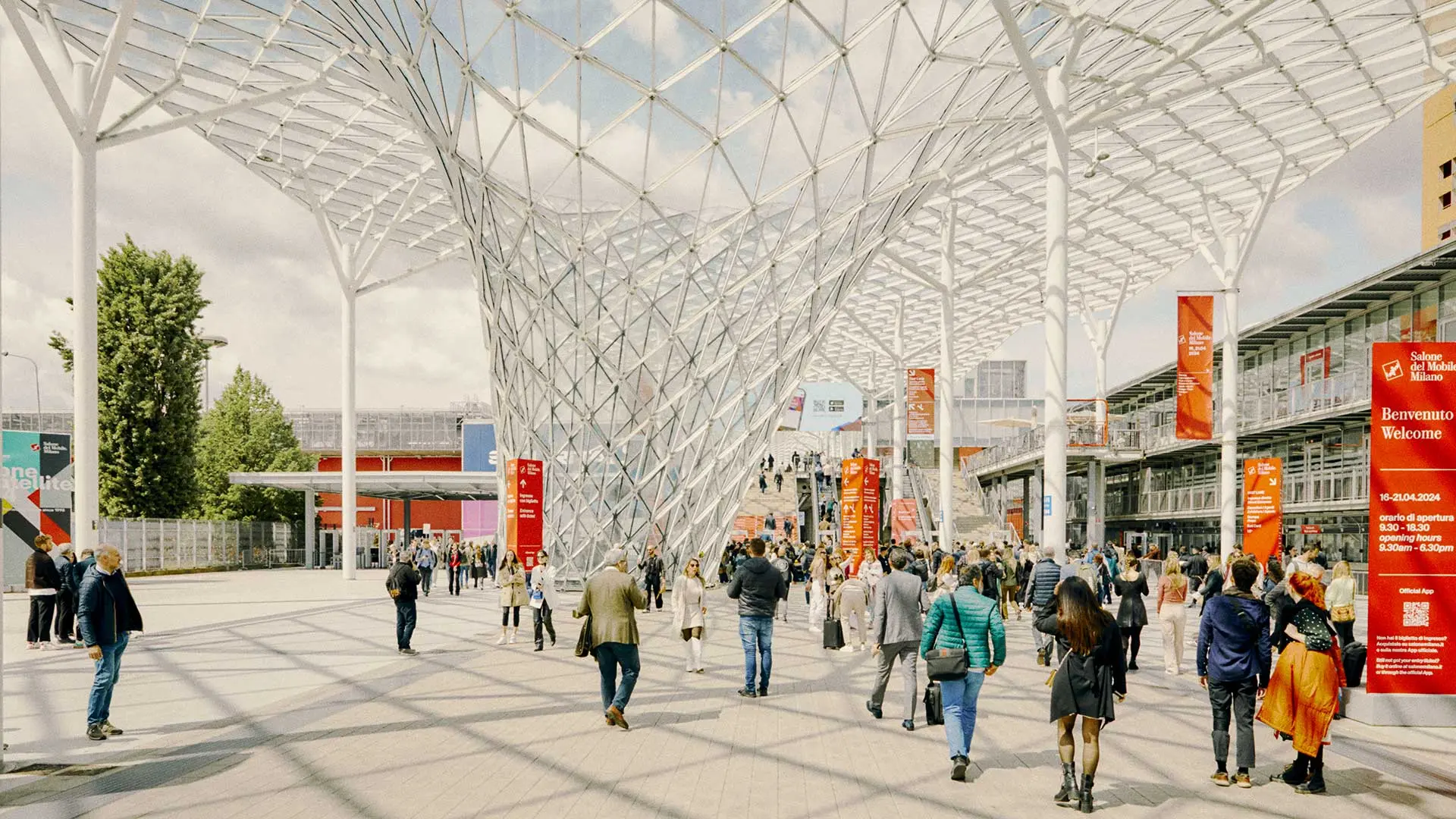
Courtesy of Salone del Mobile.Milano 2024 - Ph. Stefan Giftthaler
Introduction: A Defining Moment at Milan Design Week 2025
Each year in April, Milan is the world’s design conversation, and Milan Design Week 2025 affirmed its status as the ultimate laboratory for future-oriented interiors; a festival of design, innovation, and responsibility. The 2025 exhibitor lineup uncovered a growing consensus: design can be beautiful, but design has to be accountable.
One exhibition raised the most awareness with the international media. Casa Cork, an immersive environment by American architect David Rockwell, generated conversation - including a review for ELLE Decor - less for the splendour of the installation than for the messaging and inspiration it passed on to the exhibitors inside.
Assembled almost exclusively with cork, Casa Cork invited designers and developers to consider the environmental implications of the materials they specify.
So, why cork? Why now?
What was it about this material that warranted editorial coverage from one of the world’s leading design magazines - and what does it suggest about the trajectory the industry is on?
Why ELLE Is Talking About Cork: A Material in the Spotlight
Cork, once relegated to wine stoppers and underlayments, has become a subject of serious design discourse. The reason? It aligns beautifully with what the industry needs most:
a material that is renewable, recyclable, carbon-negative, and aesthetically versatile.
In its April 2025 feature, ELLE Decor highlighted David Rockwell’s Casa Cork not only for its visual language, but for what it represents - a shift in the priorities of interior design. As architect and designer, Rockwell collaborated with manufacturers like Amorim, the world’s largest cork producer, to create a space that was immersive, tactile, and environmentally thoughtful.
The Cork Collective, formed as part of this initiative, aims to collect and upcycle the billions of cork stoppers that end up in landfill every year - with less than 1% currently recycled globally.
What ELLE captured in its coverage was not just a story about cork - it was a story about values, and how top-tier design is beginning to measure success not just by form, but by footprint.
The attention from a mainstream publication signals a broader movement.
Design press isn’t simply aesthetic-driven anymore - it is mission-aware. Cork, in this case, became a symbol:
→ of material responsibility
→ of lifecycle thinking
→ and of the aesthetic potential of materials once considered mundane.
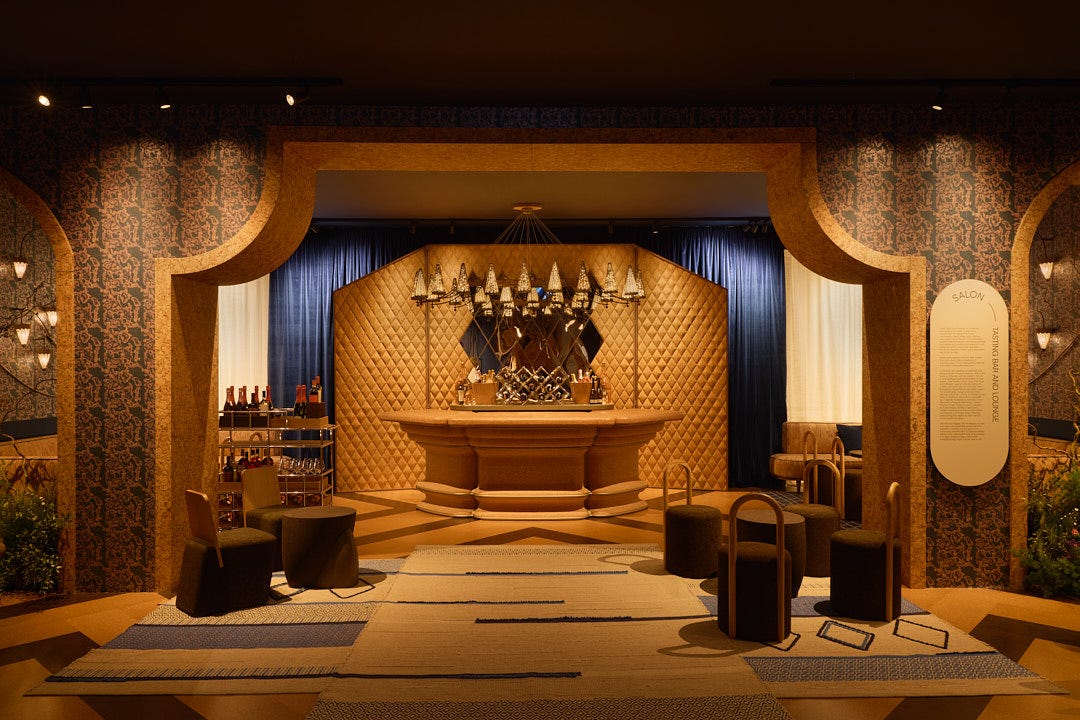
Courtesy of Rockwell Group
The Environmental Factor: How It’s Impacting Design Practices
The way we create and furnish spaces is undergoing a fundamental change - this change is motivated by aesthetics, of course, but also by environmental urgency. With climate change happening in real time and resources becoming scarce, materials have become more than just form and function; they are ethical, with implications for carbon emissions, indoor air quality, circularity, and long-term health.
This isn't anecdotal - it is quantifiable.
According to a United Nations Environment Programme report, the buildings and construction sector is responsible for almost 39% of global energy-related CO₂ emissions:
-
28% from operational energy
-
11% from materials and construction (embodied carbon)
[Source: UNEP, 2023]
Reducing the environmental impact of interior finishes and materials has become a salient fulcrum for the climate-conscious architecture and design process.
Equally, we are seeing policy and regulation tighten around sustainability. From the European Union's Green Deal to LEED and WELL certification programs, the requirements for transparency and responsibility are increasing. Designers and developers must now clearly document:
-
Where materials come from
-
How they are made
-
What happens at end-of-life
Yet the evolution isn’t only policy-driven. A growing consumer and investor demand is accelerating the shift.
As reported by McKinsey & Company and the World Economic Forum, end-users and property purchasers are actively seeking materials and finishes with:
-
Low environmental impact
-
High traceability
A recent survey by the Global Wellness Institute (2024) found that 67% of high-end property purchasers in Europe consider eco-conscious materials very important to their decision making.
In that context, designers are thinking beyond the surface and specifying materials that are:
-
✅ Non-toxic, and free of harmful VOCs
-
✅ Biodegradable or fully recyclable
-
✅ Sourced ethically and, when possible, locally
-
✅ Rated for fire resistance and durability
-
✅ Contributing to acoustic and thermal performance
Aesthetic is no longer enough to justify a product purchase.
We must also consider how the product is made - and what its impact will be over time.
Toward the Authentic from Greenwashing
As sustainable consciousness moves from the fringe to the core of interior design, the industry is confronting a long-standing issue: greenwashing.
In simple terms, greenwashing refers to exaggerated or misleading claims about the environmental benefit of a product - often the result of a scramble by brands to appear sustainable, without actually transforming their processes.
The interior design and construction industries are particularly susceptible. Until now, vague descriptors like eco-friendly, natural, or sustainable have been casually applied - often without certification, traceability, or life-cycle data. But as architects, designers, and clients become more informed and intentional, the market is showing less appetite for generalised claims.
As a result, there is growing demand for materials and products that offer measurable, verifiable impact. The most respected brands today are expected to:
-
✔️ Provide Life Cycle Assessments (LCAs) showing environmental impact from raw extraction to end-of-life
-
✔️ Disclose product contents via Environmental Product Declarations (EPDs)
-
✔️ Avoid binders, resins, or chemical coatings that release VOCs over time
-
✔️ Hold certifications from trusted bodies like Cradle to Cradle, FSC (for wood), GREENGUARD, or the EU Ecolabel
Designers working on high-end residential, hospitality, and commercial projects - particularly in Switzerland, Germany, and Nordic countries - are increasingly expected to demonstrate traceability and accountability in their material choices. Not only for compliance, but as a reflection of brand values and project quality.
Even at Milan Design Week 2025, the installations that resonated most were not just beautiful - they were transparent.
Cork walls embedded with QR codes showing their source.
Textiles made from seaweed or coffee waste.
No ambiguity - just clarity, provenance, and purpose.
As this movement gains traction, interior materials will no longer be judged solely on appearance or performance. They will be defined by:
-
What they are made from
-
Where they come from
-
How they were produced
-
Whether they can be reintegrated into a circular economy
The standard has changed - and honest materials are the future.
Milan Design Week 2025 – A Focus on Responsible Materials
At Milan Design Week 2025, sustainability was not a subplot in the unfolding story - it was the story itself. Across Fuorisalone sites, Triennale exhibitions, and brand showrooms, a collective focus on material innovation with ecological responsibility shaped the dialogue. From multi-sensory installations to research-led prototypes, the week offered a compelling example of what responsible design can look and feel like.
Casa Cork
As previously noted, Casa Cork remained at the centre of the conversation. But it was not alone. Rockwell's collaboration with Amorim and The Cork Collective set a new standard for immersive, meaningful design - blending tactility, storytelling, and material reuse.
With carbon-negative properties, sound-absorbing benefits, and regenerative harvesting, cork became more than a trend - it became a material manifesto.
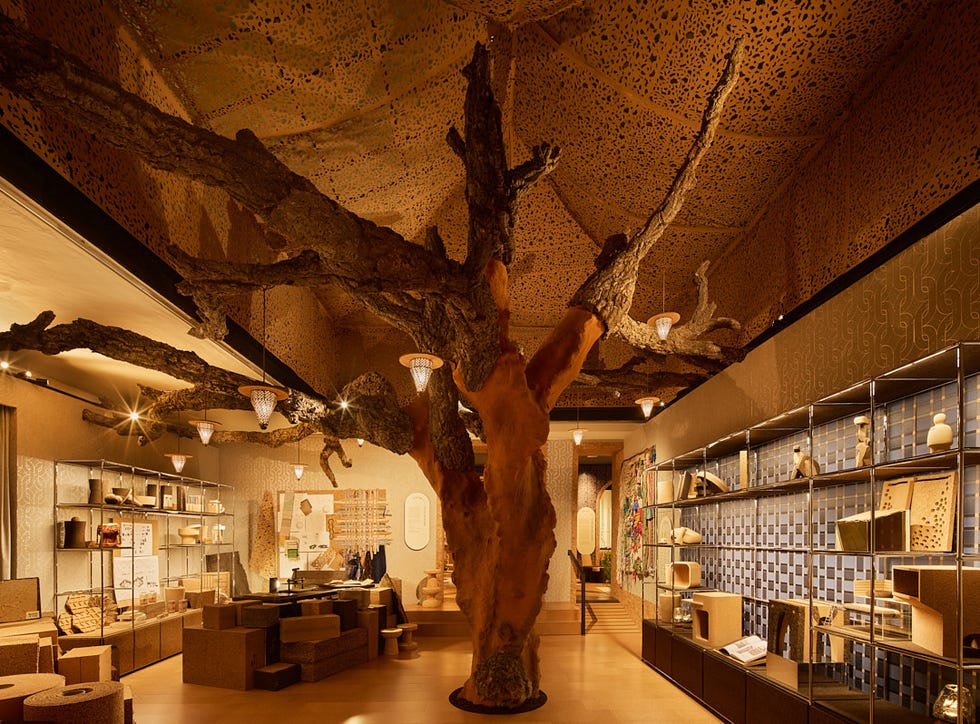
Courtesy of Rockwell Group
Salone del Mobile: Brands Are Transparent
Even within the refined halls of Salone del Mobile - long a temple of polished aesthetics - the message was clear. Leading brands like Expormim, Arper, and Hydro incorporated:
-
FSC-certified hardwood
-
Recycled aluminium
-
Textiles made from PET bottles and marine plastics
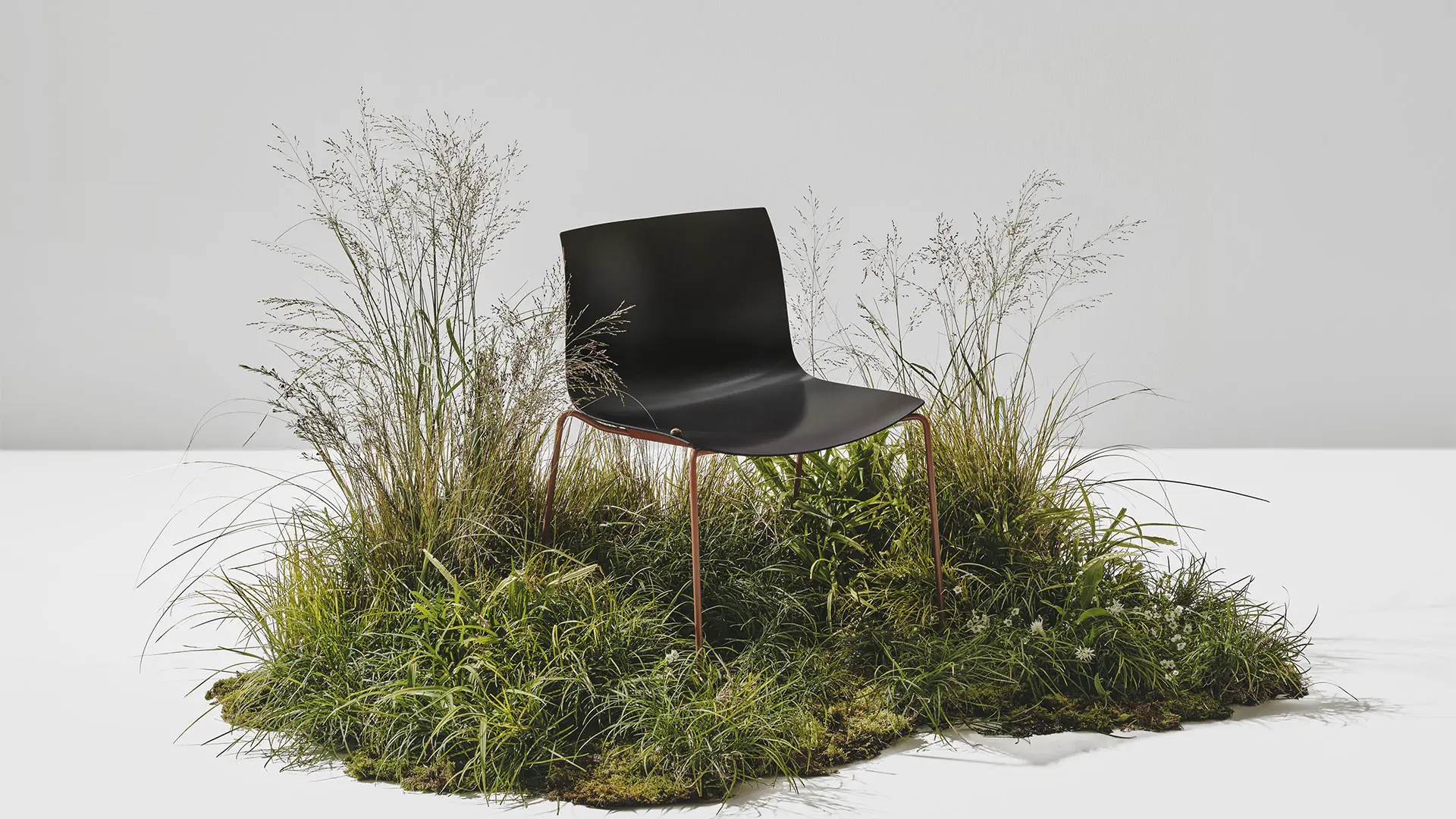
Courtesy Arper, Catifa 53 - Ph. Salva López
Milan 2025 made one thing unmistakably clear:
The materials of the future are not only beautiful - they are biodegradable, traceable, and socially conscious.
Increasingly, they are also modular and scalable, ready to be confidently specified across residential, commercial, and hospitality projects.
The ramifications for designers, specifiers, and developers are profound.
This is no longer a fringe conversation - it’s becoming the new normal.
6 Eco-Sustainable Innovations Bringing Future Potential
Sustainable interiors aren’t built on one miracle material like bamboo or reclaimed wood. The future lies in a suite of high-performing, bio-based and circular materials - each with its own benefit, beauty, and logic for use.
Here are six innovations from Milan Design Week 2025 and beyond that are paving the way:
1. Mycelium Composites
What it is: Mycelium is the root system of fungi, grown into forms for acoustic panels, decorative tiles, and light structural components.
Why it matters:
-
100% biodegradable
-
Grows in days
-
Waste-free
-
Naturally fire-retardant
Who is doing it: Studio Peipei, Mogu (Italy), collaborations with TU Delft and Politecnico di Milano
🔗 mogufungi.com
2. Recycled Terrazzo
What it is: A contemporary take on terrazzo using crushed glass, stone offcuts, or salvaged ceramics from demolition.
Why it matters:
-
Diverts construction waste from landfill
-
Infinitely recyclable
Who is doing it: Foresso, Concreo, exhibited by Isola Design
🔗 foresso.co.ukCourtesy of Foresso

3. Hempcrete Panels and Wall Finishes
What it is: A bio-composite of hemp hurds and lime, engineered into prefab wall panels and natural coatings.
Why it matters:
-
Naturally insulating
-
Carbon-negative during growth
-
Recyclable at end-of-life
Who is doing it: IsoHemp, Hempitecture, and pavilions at Alcova 2025
🔗 isohemp.com
4. Seaweed Textiles and Coatings
What it is: Kelp and algae-based fibers and biopolymers used for wallpaper, upholstery, or acoustic wall panels.
Why it matters:
-
Grows quickly
-
Requires no arable land or freshwater
-
Fully biodegradable
Who is doing it: Lund University, Algiknit, SeaMe (NL) – prototypes shown at Alcova and Dutch Design Week
🔗 algiknit.com
5. Bio-Leather from Food Waste
What it is: Leather alternatives made from apple, grape, and pineapple skins - by-products of food processing.
Why it matters:
-
Repurposes agro-waste
-
Plant- and seaweed-based
-
Requires low energy for production
Who is doing it: Vegea (Italy), Desserto, Frumat – used for wall coverings, headboards, and hospitality seating
🔗 vegeacompany.com
6. Re-Engineered Clay Composites
What it is: Earth-based wall tiles and finishes stabilized with natural additives, not polymers.
Why it matters:
-
Abundant
-
Low carbon
-
Breathable
-
Sourced locally
Who is doing it: Clayworks (UK), Matter Design Studio – featured in Triennale’s “Material Immaterial” exhibition
🔗 clay-works.comCourtesy of Clayworks, Studio Baab Design, Photographs: Mohammed Ashkanani

These are not conceptual experiments - they are market-ready, design-minded, and architect-approved. And more importantly, they support the transition away from synthetic polymers and petrochemical composites toward materials with clear, ecological intelligence.
Next, we explore Kandes' reinterpretation of one of the oldest known building materials - gypsum - through the lens of environmentally conscious design.
Providing Gypsum a Fresh Perspective – Kandes Panels
While emerging materials such as mycelium and algae are gaining popularity in the press, one of the most dependable and natural materials already present in the built environment deserves renewed attention: gypsum.
Today, as the interior design sector moves toward sustainably sourced materials and soft manufacturing processes, it is time to re-evaluate gypsum - not as a basic construction filler, but as a multi-functional, healthy, and sustainable solution for more design-conscious spaces.
What Makes Gypsum Sustainable?
Gypsum is a natural mineral composed of calcium sulfate dihydrate. It is:
-
✔️ Abundant and recyclable
-
✔️ Low-energy to process compared to cement or synthetics
-
✔️ Non-toxic, with no off-gassing or VOCs
-
✔️ Totally safe, even under high heat – classified A1 non-combustible under European fire safety standards
-
✔️ Reusable and circular – fully reworkable without loss of integrity
What makes gypsum truly exceptional is its closed-loop recyclability. Scraps can be crushed, rehydrated, and recast without chemical alteration.
With no polymer additives, gypsum offers a pure material experience - not too rigid, not too fragile - breathable, long-lasting, and endlessly restylable.
Kandes 3D wall panels, made from unlaminated, all-natural gypsum, preserve this material purity. No resins, no synthetics - only raw, refined performance.

How Can You Get Creative with Your Design Language?
At Kandes, gypsum is not a hidden layer. It is treated as a defining design material, precision-molded into:
-
Geometric, slotted, or flowing, wavy patterns
-
Architectural forms that add structure, shadow, and sculptural rhythm to interiors
-
🏠 Residential projects – such as living rooms or refined TV feature walls
-
🛍️ Retail environments – where visual texture tells a brand story
-
🏨 Hospitality spaces – from hotel lobbies to lounge areas
-
🏢 Commercial interiors – where fire resistance and eco-certification are essential
And because all Kandes panels are paintable, designers and developers can match or accent any palette - without relying on chemically dyed surfaces.
Kandes works exclusively with pure, all-natural gypsum -
✔️ No plastics
✔️ No resins
✔️ No unsafe additives
Kandes's principles promote purity, safety, functionality, and longevity - from “year 1” to “year 100.”
In today’s context of elevated aesthetic expectations, growing environmental awareness, and rising demand for material integrity, gypsum is no longer a relic of the past.
It is, as redefined by design, a material of the future.
Kandes 3D Wall Panels – Where Design Integrity Meets Environmental Principles
As design decisions increasingly reflect both aesthetic sensibilities and ethical values, Kandes offers a solution that satisfies both:
high-quality 3D wall panels made of all-natural gypsum, designed for modern interiors and mindful living.
The Right Material
Every Kandes panel begins with pure gypsum - a bio-safe mineral requiring minimal processing, and free from harmful additives.
Unlike common wall claddings made from polymer blends, MDF cores, or composite foams, Kandes panels are crafted without resins or synthetics.
This means the surfaces are:
-
✔️ A1 non-combustible, meeting the highest European fire safety standard
-
✔️ Free of VOCs, formaldehyde, and microplastics
-
✔️ Paintable and malleable, with unlimited finish options
-
✔️ Eco-conscious
This integrity is more than a feature - it's a foundation.
Kandes wall panels offer architects and interior designers a responsible, reliable material for sustainability- and wellness-minded projects.

Design That Complements
Kandes offers collections that range from geometric and structured to soft, flowing patterns, bringing depth and motion to any wall surface.
Kandes panels can be used to create:
-
🖼️ A permanent accent wall in a residential interior (e.g., a TV wall)
-
🏨 A visual feature in a boutique hotel, near a lobby bar or lounge
-
📐 Perfect geometry, achieved through precision molding
-
💡 Seamless LED integration, supporting indirect or task lighting
-
🔊 Improved acoustic performance, especially in layered or curved designs
-
🧱 Modular capacity, from small surfaces to full feature walls
Designers appreciate that every panel is ready for custom finishing, enabling limitless color applications - from minimalist tones to bold brand environments.
Designed for Designers, Built for Projects
From a practical perspective, Kandes 3D wall panels are ideal for:
-
🏢 Commercial interiors, where fire-rated, sustainable materials matter
-
🛎️ Hospitality spaces, where durability meets design
-
🛍️ Retail environments, where texture and lighting enhance user experience
-
🏠 Home settings, where wellness, safety, and creative freedom matter
With a brand rooted in Swiss-based quality standards, Kandes delivers more than products - it delivers confidence:
That every wall specified will be beautiful, safe, and sustainable.
Designing for the Future – A New Manual for Eco-Conscious Interiors
The materials we select today are no longer just building blocks - they are intentions.
As the interior design world embraces a mindset that’s less wasteful and more genuinely conscious, the aesthetics of the future are increasingly shaped by:
-
Transparency
-
Traceability
-
Renewability
-
Non-toxicity
What was once layered on as sustainability is now embedded into the visual language and function of space - influencing not only how interiors look and feel, but how they interact with both people and planet.
This narrative came alive at Milan Design Week 2025, where post-pandemic reimagination has brought renewed attention to materials - from seaweed to cork and plaster to clay. Today’s designers are asking not just what is new, but:
“What is necessary?”
“What is right?”
For this reason, Kandes represents more than just product design.
It offers a partnership for purpose-driven design.
When architects and developers choose Kandes 3D wall panels, they are choosing:
-
One of the finest surface treatments available
-
A material reflecting the Premium quality mindset
-
A non-combustible, toxin-free, eco-conscious choice
… and a reflection of the values shaping the next generation of built environments.
Whether applied in:
-
A refined residential living room
-
A boutique hospitality suite
-
Or a visionary commercial concept
Kandes panels represent a departure from compromise - toward clarity, safety, and meaningful aesthetics.
Designing for the future means designing with intention.
And when intention meets innovation, materials like gypsum - as reimagined by Kandes - become icons of a better, smarter built environment.
Condividi:
Illuminazione d'Ambiente: Pannelli 3D con LED Integrato
Riscoprire il gesso architettonico nel design contemporaneo